

Safety tags and wearables have played an important role in the evolution of warehouse safety. By equipping pedestrians and vehicles with personal devices, organizations introduced proximity alerts and basic situational awareness into environments that were previously blind. For many years, this represented meaningful progress.
Today, however, warehouses operate under very different conditions. Traffic density has increased, layouts change more frequently, automation is being introduced alongside manual operations, and safety expectations are higher than ever. In this context, the limitations of tag-based safety systems are becoming increasingly apparent.
Modern warehouse safety no longer depends on knowing that objects are close. It depends on understanding what is happening, why a situation is risky, and how to intervene in time.
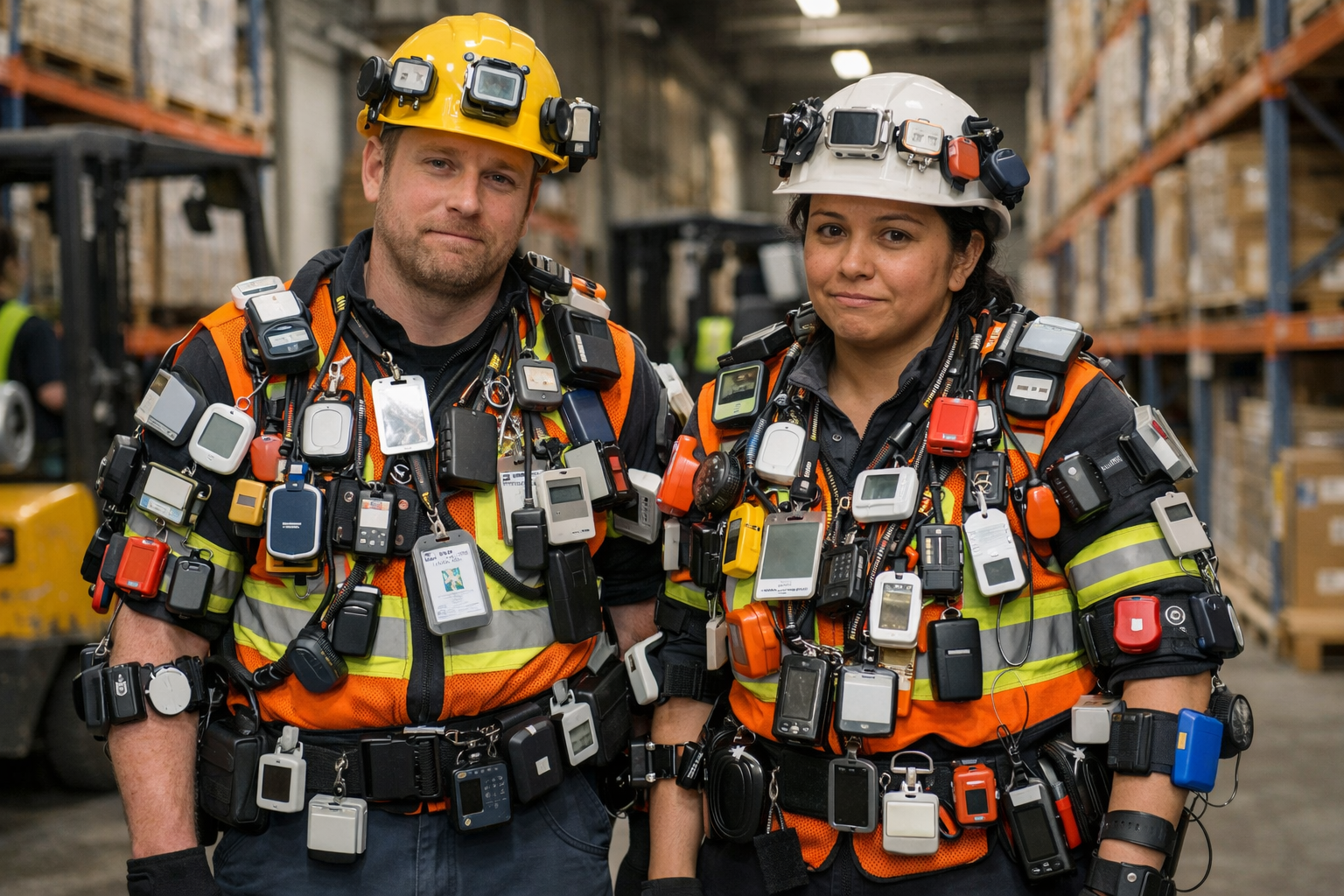
The structural limitations of safety tags and wearables
Most safety tags rely on radio-based positioning technologies such as RFID, BLE, Wi-Fi, or UWB. These systems estimate location through signal strength, time-of-flight, or angle-of-arrival measurements between mobile tags and fixed anchors. While effective in controlled environments, warehouses are among the most challenging settings for radio-frequency positioning.
Large metal racks, moving forklifts, stacked goods, and constantly changing layouts create multipath interference and non-line-of-sight conditions. Numerous studies show that RF-based indoor positioning suffers from unstable accuracy and latency in industrial spaces, especially when high precision is required for safety use cases.
To compensate, tag-based systems require dense infrastructure, ongoing calibration, and regular maintenance. This increases total cost of ownership and makes scalability difficult, particularly in brownfield warehouses where flexibility and retrofit capability are essential.
From a safety perspective, wearables introduce an even more fundamental challenge: human dependency. Pedestrian safety systems assume that workers consistently wear, charge, and correctly use their tags. In reality, devices are forgotten, removed for comfort, shared between shifts, or left uncharged. This creates invisible safety gaps in environments where reliability should be absolute (National Institute for Occupational Safety and Health, Wearable Technologies in the Workplace, https://www.cdc.gov/niosh/docs/2020-108/default.html).
Equally important is the lack of context. Safety tags can indicate proximity, but they do not understand visibility, relative speed, line-of-sight, or intent. As a result, many systems rely on static distance thresholds, often leading to false alarms and alarm fatigue. Over time, operators begin to distrust or ignore alerts, undermining the effectiveness of the safety system itself.
Why proximity alone is no longer sufficient
Warehouse safety is shifting from reactive accident reporting to proactive risk prevention. Near-misses, traffic patterns, blind intersections, and behavioral trends are now widely recognized as leading indicators of safety performance.
Pure location data struggles to support this shift. Coordinates alone cannot explain why certain zones consistently generate near-misses or why specific interactions repeatedly create risk. Without contextual understanding, safety data remains descriptive rather than preventative.
This becomes especially clear in forklift-to-forklift interactions.
Forklift-to-forklift safety: why positioning matters more than vision
A significant share of serious warehouse incidents occurs between forklifts themselves, particularly at blind intersections, narrow aisles, and crossing traffic flows. These scenarios demand extremely reliable, low-latency awareness between vehicles.
For this reason, Essensium deliberately does not rely on camera-based vision for forklift-to-forklift safety. Vision systems are inherently limited by line-of-sight, lighting conditions, dust, and occlusions. In dense warehouse traffic, relying on cameras to detect other vehicles introduces uncertainty precisely where safety must be most reliable.
Instead, Essensium uses high-precision real-time positioning to determine the exact location of every forklift, multiple times per second. Each vehicle continuously knows where it is within the warehouse and where other vehicles are relative to it, independent of visibility. This shared positional intelligence enables the system to calculate relative trajectories, closing speeds, and collision paths in advance.
Because this positioning is absolute and continuously updated, Essensium can predict risk at blind corners, behind racks, or in high-traffic intersections where vehicles cannot physically see each other. In these scenarios, positioning remains reliable where vision would fail.
This approach is supported by research showing that precise relative positioning and trajectory prediction are more robust for vehicle-to-vehicle collision prevention in structured industrial environments than perception-only approaches.
Where vision does play a critical role: pedestrian safety
While positioning is the foundation for forklift-to-forklift safety, pedestrian protection presents a different challenge. People are unpredictable, can appear suddenly, and cannot be expected to carry or wear a device at all times.
This is where vision adds essential value. Essensium uses camera-based AI specifically for vehicle-to-pedestrian detection, allowing the system to identify people in real time, interpret their movement, and distinguish between safe and unsafe situations. Vision makes it possible to detect pedestrians without relying on wearables, eliminating compliance risks and blind spots.
By combining positioning for vehicles with vision for pedestrians, Essensium avoids the weaknesses of single-technology approaches. Each technology is applied where it is strongest, resulting in a safety system that is both reliable and context-aware.
From safety alerts to safety intelligence
Safety tags and wearables helped warehouses move from no visibility to basic proximity awareness. But modern operations demand more than alerts, they demand understanding.
Essensium addresses the structural limitations of tag-based safety by combining high-precision positioning with targeted use of vision. This enables predictive risk detection, dynamic safety zones, and proactive intervention, without relying on human compliance or extensive infrastructure.
The result is a safety system that does not merely react to danger, but understands how the warehouse actually operates in real time. In that sense, the future of warehouse safety is not about choosing between tags, positioning, or vision. It is about combining the right technologies to move from proximity alerts to true safety intelligence.