
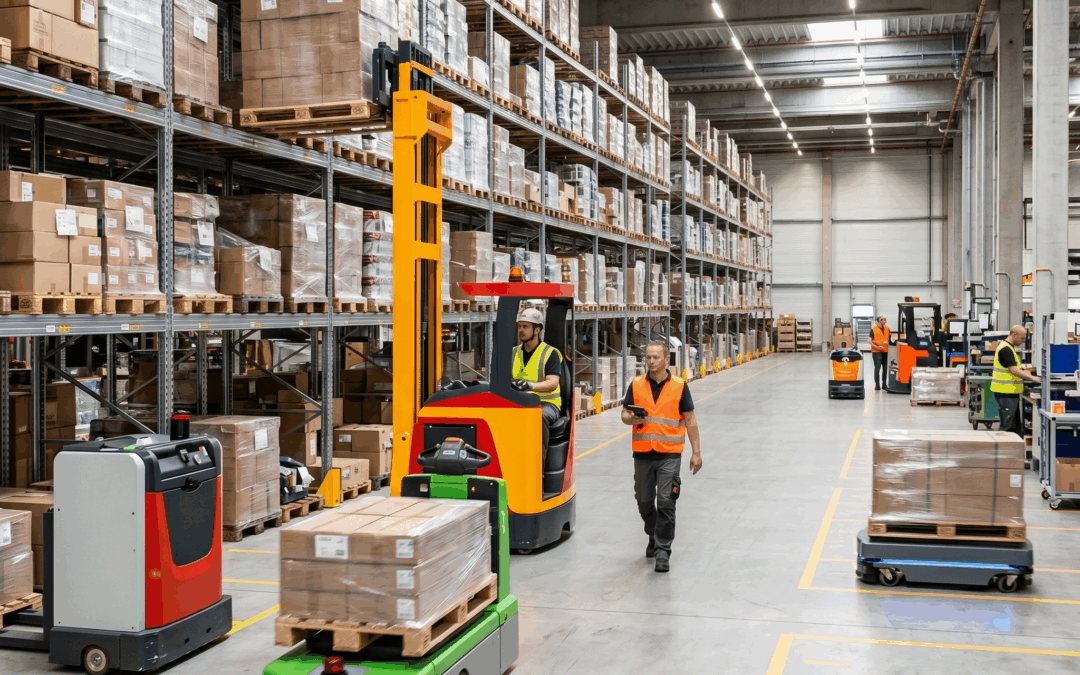
It’s 14:00 on a Tuesday. Peak shift. In aisle C-7, a reach truck reverses out of a racking bay. Six metres away, an AMR rounds the corner with a loaded pallet. And between them, head down and scanner in hand, an operator steps out to check a label.
Three actors. One blind corner. One second.
Three systems are watching three kinds of traffic, and none of them is watching the same floor. The truck has its sensors. The robot has its own. The operator has a high-vis vest and a habit of glancing left. That isn’t one safety setup. It’s three fragmented ones, hoping to overlap at the right moment.
Nothing happens this time. The truck driver glances left out of habit. But “nothing happened” isn’t a safety record. It’s a near-miss nobody logged, and on most warehouse floors today, that scene repeats dozens of times a shift.
Ten years ago, that same aisle had one kind of traffic: forklifts, driven by people who knew the floor. Today it has three. Manual forklifts. Autonomous mobile robots. And pedestrians walking between both. That isn’t a future scenario. It’s most warehouse floors right now. Your fleet is already mixed. The question is whether your safety setup kept up, or stayed fragmented.
Three types of traffic, one set of blind spots
AMRs were sold as a safety upgrade. They follow rules, they don’t get tired, they stop on a dime. All true.
But here’s what the brochure skips. An AMR is only as safe as its ability to predict what the unpredictable thing next to it will do. And the unpredictable thing is a forklift driven by a human, under shift pressure, mid-conversation, on hour seven of eight.
Mixed traffic doesn’t add risk. It multiplies it. In a single-traffic aisle, every interaction is forklift-to-forklift or forklift-to-pedestrian, one relationship to manage. Add robots and every one of those interactions now has a third party in it. The forklift has to account for the pedestrian and the robot. The robot has to account for both. The pedestrian is trusting two machines at once to see them. More actors, more crossing paths, more moments where safety depends on someone else getting it right.
Most safety setups were built for the old aisle: one traffic type, predictable patterns, human judgement filling the gaps. They were never designed for a floor where a human, a machine and an autonomous vehicle converge at the same blind corner at the same second.
The cost you’re already paying, but don’t see
The cost of mixed-traffic risk isn’t waiting in the future. You’re paying it now, every shift, in a currency that doesn’t show up on a P&L.
You pay it in near-misses that never get logged, each one a collision that didn’t happen by luck rather than by design. You pay it in operators who slow down at every corner because they don’t trust what’s around it. You pay it in the productivity tax of caution, because a floor where people hesitate is a floor that moves slower.
And when a real incident does land, the bill arrives all at once: downtime, damaged goods, an insurance claim, an investigation, and the much longer cost of operator confidence that doesn’t come back quickly. The European warehousing sector still absorbs tens of thousands of forklift accidents a year. Most of them are preventable. In a mixed-traffic environment, “preventable” only counts if your system can see the prevention coming.
The question for a warehouse leader isn’t “can we afford a safety layer for hybrid traffic?” It’s “what is the current setup already costing us, and who’s adding it up?”
Why the usual fixes don’t fix it
Tags and wearables. They tell a system where a person is, provided the person is wearing the tag, charged it, and didn’t leave it in a locker at break. In mixed traffic, “if” is not a safety strategy. The one operator who forgets is the one the robot doesn’t see. And the heavier the traffic, the worse the odds.
Segregation. Separate the robots, separate the people, problem solved. That holds until throughput pressure collapses the lanes back together, because dedicated robot zones cost floor space, and floor space costs money. Segregation works beautifully on the layout drawing. On the live floor at peak, the barriers move.
Faster sensors. A sensor that detects 200 milliseconds sooner is still reacting. In a three-way interaction, reacting isn’t enough, because by the time something is detected, the geometry is already set. You need a system that anticipates, one that reads intent and context across every vehicle and person on the floor at once, and acts before the paths cross.
There’s a common thread here. Each of these fixes treats the floor as a set of separate problems. That’s the fragmentation. Mixed traffic isn’t a separate-problems situation. It’s one shared environment, and it needs to be managed as one.
What a hybrid-ready setup actually looks like
Essensium SafeTrack™ gives every forklift 360° vehicle-to-vehicle and vehicle-to-pedestrian awareness, and predicts risk before paths cross: automatic slowdowns, configurable safety zones, lighttower feedback the operator can read at a glance. No tags on people. No anchors on walls.
It works with any fleet, manual or autonomous or both, and retrofits onto trucks you already own in weeks.
That last point matters more in a hybrid warehouse than anywhere else. In a hybrid warehouse, no two trucks are the same: reach trucks of different ages, forklifts from different brands, robots from a different vendor entirely. A safety layer that only works if everything is new, or all one brand, isn’t a safety layer. It’s a procurement project with a safety label on it.
SafeTrack™ sits on top of all of it. The AMR, the 12-year-old reach truck, the brand-new forklift all get the same awareness, the same shared logic, the same floor treated as one environment instead of three.
The proof: Livlina
When Livlina opened its pharmaceutical logistics site in Sint-Niklaas, the floor was exactly this problem. With 35+ electric vehicles, narrow aisles and mixed traffic, it was the textbook hybrid warehouse, and a pharma environment where there’s no margin for an incident.
They didn’t wait for one to act. Since go-live they’ve recorded zero serious incidents, measurably higher operator confidence, and full floor visibility through the Customer Cockpit.
Their Lead Inbound, Frank Van de Velde, put it plainly: “Thanks to Essensium, our people feel safer on the floor, and our managers have the insights to keep operations running smoothly.”
Their advice to anyone running mixed traffic? “Don’t wait for a serious incident.”
Safety is the start, not the finish
Notice the second half of that quote: the insights to keep operations running smoothly. That’s the part most safety stories leave out.
Once SafeTrack™ is on every truck, the floor isn’t just safer. It’s instrumented. Every vehicle becomes a data point. The Customer Cockpit turns that into heatmaps of where traffic actually converges, congestion analysis of where the floor slows down, and near-miss reporting that shows you the dangerous corner before it produces an incident report.
That’s where safety quietly becomes productivity. A floor where operators trust what’s around the corner is a floor that stops hesitating. The same system that prevents collisions also shows you where empty forklift runs are bleeding margin, and across the industry, empty runs of 60% can be brought down toward 30%. RAJA, working with Essensium, cut outbound errors by 90% on the productivity side of the same platform.
You don’t buy a safety system and a productivity system. You make the floor visible once, and safety, productivity and data all run on it. One floor, one platform. The opposite of fragmented.
The aisle isn’t going back
Hybrid warehouses aren’t a trend that peaks and fades. More automation is coming, not less, and every robot you add is one more actor in an aisle that already has forklifts and people in it.
The safety question isn’t whether your floor becomes mixed traffic. It already is. The real question is whether your safety setup was built for the aisle you have now, or the one you had ten years ago.
Your fleet is mixed. Your safety setup shouldn’t be fragmented.